

Making sense of the NFL’s Week 8 SNF flex dilemma
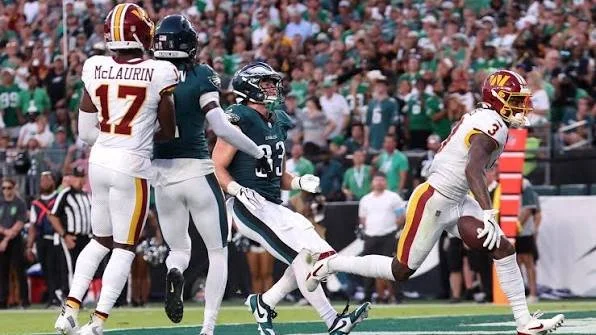
It’s still quite early in the 2026 NFL season, but we’ve already seen one NFL schedule change (Bears-Packers from 4:25 to 1:00 PM in Week 5) and we could be staring at another in Week 8.
As I write this just past midnight on October 20, a major decision looms. The Washington Commanders (1-4-1) are scheduled to host the Philadelphia Eagles (2-4) on Sunday Night Football in Week 8, and the deadline to flex the game out of primetime is today.
This was a game that the NFL probably never expected to consider flexing. The exciting, young Commanders, led by Jayden Daniels, were set to face an Eagles team coming off five consecutive playoff appearances and a recent Super Bowl title in a classic NFC East rivalry. These two teams met in the conference championship just two seasons ago. But after a rocky start to the season from the Commanders and a plethora of injuries for the Eagles, this game is in jeopardy of a flex.
Let’s break it all down.
Have the Eagles been flexed out of Sunday Night Football before?
Since Sunday Night Football (SNF) flex scheduling was introduced in 2006, the Philadelphia Eagles have been flexed out of SNF just twice:
2019, Week 12 vs. Seattle: This was actually a strong matchup on paper, featuring an 8-2 Seahawks team traveling to face a 5-5 Philadelphia team that was sitting just one game back in the NFC East. Under most circumstances, this game likely would have remained on SNF. However, FOX had two marquee matchups scheduled for its 4:25 PM window.
Their A game was the Dallas Cowboys (6-4) at the New England Patriots (9-1), a classic ratings draw featuring Tom Brady against America’s Team. Meanwhile, the Green Bay Packers (8-2) were set to visit the San Francisco 49ers (9-1) in a pivotal NFC showdown. With two massive games competing in the same window, the NFL opted to move the latter to SNF and shift Seahawks-Eagles to 1pm on FOX.
This move was a win-win for both NBC and FOX. FOX gained a strong early-window headliner in Seahawks-Eagles, delivering it to most of the country. Without Packers-49ers competing for coverage in the late afternoon, FOX aired Cowboys-Patriots nationally. Meanwhile, NBC landed a much more consequential matchup on paper. Although the 49ers ended up blowing out the Packers, it was a game that ultimately decided the No. 1 seed in the NFC and ended up being a Conference Championship preview.
2024, Week 9 vs. Jacksonville: Ironically, the Eagles were flexed out of SNF the same year that they went on to win the Super Bowl. However, the Jaguars were struggling to start their 2024 campaign and posted a record of 2-6 heading into their game against the Eagles.
The NFL instead opted to flex Colts-Vikings into SNF, featuring a 4-4 Indianapolis team visiting a 5-2 Vikings team. Both of these teams had exceeded expectations to start the season, and this game happened to be a rematch of the largest comeback of all time, which occurred in 2022, when the Vikings erased a 33-0 deficit to beat the Colts. With Jacksonville struggling and Minnesota emerging as a contender in the NFC, the NFL capitalized on an opportunity to improve its primetime offering.
The common thread between these two flexes is that the Eagles’ own performance was never the primary reason for their flex out of SNF. In 2019, a unique set of circumstances allowed the NFL to flex a good matchup for an even better one in a mutually beneficial exchange between NBC and FOX. In 2024, Philadelphia’s struggling opponent weakened the intrigue of the matchup, even though the Eagles were playing well.
This brings us to 2026, where the Eagles’ own struggles could be a major factor in a potential flex.
Is the flex even possible?
If you were to take a quick glance at the slate for Week 8, you might think that a SNF flex would be an obvious choice. There are around five matchups that seem more enticing to be played on SNF rather than Eagles-Commanders. However, each comes with its own scheduling complications.
Baltimore Ravens (4-2) at Buffalo Bills (5-1): This is an incredible matchup, and one that likely left many NFL fans, myself included, scratching their heads when it was originally scheduled for 1:00 PM back in May. Since Josh Allen and Lamar Jackson entered the league in 2018, these teams have developed a compelling rivalry, meeting seven times, including two playoff matchups that both went Buffalo's way.
On paper, flexing this game into SNF seems like a no-brainer. Unfortunately, the Ravens are scheduled to play on Thursday Night Football (TNF) the following week. The NFL has consistently avoided scheduling teams for SNF immediately before TNF since 2018, making this matchup an extremely unlikely flex candidate.
Minnesota Vikings (5-0) at Detroit Lions (3-2): This is a pivotal midseason matchup that could have major implications for the NFC North race. The Vikings remain undefeated, while the Lions continue to be one of the league's most entertaining teams thanks to their explosive offense. However, there's an important broadcast restriction that complicates this matchup, along with several others on the Week 8 slate.
Since 2023, it has been a requirement that one instance of each divisional matchup must air on a Sunday afternoon network (FOX or CBS). In nearly every case, FOX carries NFC divisional matchups, while CBS carries AFC divisional matchups. When one meeting is assigned to a different network, typically in primetime, the other is generally preserved for its respective Sunday afternoon broadcaster.
In this case, the Lions are already scheduled to visit Minnesota on SNF in Week 15. Moving their Week 8 meeting into primetime would therefore be highly unlikely.
Additionally, FOX has the ability to protect a matchup from being flexed each week. Given the quality of this game, I would expect FOX to fight to retain it as the centerpiece of its Sunday afternoon slate, potentially with Kevin Burkhardt and Tom Brady on the call.
Cleveland Browns (4-2) at Pittsburgh Steelers (4-2): Through six weeks, all four AFC North teams have winning records, making this one of the most competitive divisions in football. With both Cleveland and Pittsburgh sitting at 4–2, this matchup could have significant implications for the division race.
The Browns won the first meeting 27–24 in Week 4 on Thursday Night Football. With that game airing on Prime Video, CBS is positioned to retain the second meeting as part of its Sunday afternoon inventory, making an SNF flex unlikely under these restrictions.
Indianapolis Colts (2-4) at Jacksonville Jaguars (4-2): Despite their recent loss to the Titans, the Colts remain second in the AFC South and could make up valuable ground with an upset in Jacksonville.
However, the Jaguars are scheduled to play on TNF the following week. As with Ravens–Bills, the NFL's longstanding avoidance of SNF-to-TNF turnarounds makes this an unlikely candidate.
Kansas City Chiefs (5-0) at Denver Broncos (4-2): This 4:25 PM matchup features the top two teams in the AFC West and is arguably one of the strongest games on the entire Week 8 slate.
Kansas City won the first meeting 31–10 on Monday Night Football (MNF), leaving CBS positioned to carry the second installment of this divisional rivalry.
Beyond the broadcast considerations, CBS has every reason to keep this game. With two of the AFC's best teams facing off, I'd expect Jim Nantz and JJ Watt to be on the call for what should be the network's marquee afternoon matchup. A flex to SNF seems highly unlikely.
Other Potential Candidates
There are a couple of other matchups worth mentioning, although neither seems compelling enough to justify moving Eagles–Commanders off of SNF.
The Las Vegas Raiders (3–3) travel to New York to face the Jets (2–4). Both teams have shown improvement from last season, but neither has established itself as a serious contender.
Meanwhile, the Arizona Cardinals (2–4) visit the Dallas Cowboys (2–4). Arizona is coming off an impressive upset victory over the Rams, and the Cowboys are always a draw. However, a matchup between two teams with losing records hardly represents a clear upgrade over the currently scheduled SNF game.
So… is NBC really stuck with Eagles-Commanders?
While these divisional broadcast protections may seem definitive, they are ultimately intended to preserve valuable inventory for FOX and CBS rather than necessarily serve as unbreakable rules. Although the NFL has yet to deviate from this arrangement in the three completed seasons since its introduction, Week 8 could present a compelling reason to reconsider.
For context, 2023 marked the beginning of the NFL's new 10-year media rights agreements, worth approximately $110 billion, which introduced several major changes to how games are distributed across networks.
One significant change was the introduction of Monday Night Football flex scheduling, followed by Thursday Night Football flex scheduling beginning in 2024. Additionally, CBS had traditionally held the rights to Sunday afternoon games featuring an AFC road team, while FOX carried games featuring an NFC road team. Under the new agreements, the NFL moved away from this rigid conference-based structure, treating all 272 games as “free agents” to give itself greater flexibility to assign games to either network.
Both changes potentially disadvantaged FOX and CBS. With their traditional conference-based exclusivity reduced and additional flex windows putting more of their games at risk of being moved to primetime, the league introduced protections to preserve valuable inventory for its Sunday afternoon partners. One such protection has been the guarantee that at least one meeting between division rivals remains on the respective conference's traditional network.
In Week 8, three matchups fall into this category: Vikings–Lions, Chiefs–Broncos, and Browns–Steelers.
This raises an interesting question: How strongly would FOX and CBS insist on retaining these games? And under the right circumstances, could either network be persuaded to give one up?
Which game would FOX or CBS most likely give up?
Of the three divisional matchups, Browns–Steelers seems like the most realistic candidate for a potential SNF flex.
CBS will almost certainly want to retain Chiefs–Broncos in its 4:25 PM window, while flexing Vikings–Lions would be unnecessary given that the teams' Week 15 rematch is already scheduled for SNF. With both teams performing well, that game appears likely to retain its primetime slot.
Browns–Steelers, however, presents a more interesting situation.
The matchup is currently scheduled for 1:00 PM on CBS, alongside Ravens–Bills. While Browns–Steelers is an attractive divisional rivalry between two 4–2 teams, it is clearly the second-best game in that window and will have to compete with Ravens–Bills for national coverage.
If Browns–Steelers were moved to SNF, Eagles–Commanders would presumably take its place on CBS at 1:00 PM. Although that matchup would still command a sizable audience, CBS could potentially distribute Ravens–Bills to a greater portion of the country.
In that sense, this could become a mutually beneficial exchange, similar to the 2019 Seahawks–Eagles flex discussed earlier. The difference is that this move would likely benefit NBC considerably more than CBS.
Moving Browns–Steelers to SNF would mean that both meetings between these division rivals aired in primetime this season. The last comparable instance occurred in 2022, when the Chiefs and Chargers met on TNF and SNF. It would also mark the first such occurrence under the current media rights agreements, breaking a precedent that has held since 2023.
The question, then, is how strictly the NFL and its broadcast partners adhere to this precedent. More importantly, have there been previous instances where these protections prevented an otherwise logical flex?
What have previous flex decisions looked like?
After reviewing each week's schedule from 2023 through 2025, I found only two instances where this divisional broadcast protection may have played a meaningful role in preventing a flex, both occurring in 2025.
2025, Week 13: Broncos–Commanders vs. Texans–Colts
NBC was scheduled to air the 9–2 Broncos visiting the 3–8 Commanders on SNF. Meanwhile, the 6–5 Texans were traveling to Indianapolis to face the 8–3 Colts in a pivotal AFC South matchup.
With Washington struggling and dealing with injuries at quarterback, Texans–Colts appeared to be a strong alternative. The NFL reportedly gave serious consideration to making a change.
However, the other meeting between Houston and Indianapolis was scheduled for Week 18, creating somewhat of a gray area.
Under the scheduling patterns observed since 2023, when one meeting between division rivals falls in Week 18, the other has consistently aired on the conference's traditional Sunday afternoon network. This effectively preserves the network's guaranteed divisional inventory while giving the NFL maximum flexibility to determine Week 18 broadcast assignments closer to the end of the season.
Still, it's unclear whether this protection actually prevented Texans–Colts from being flexed. NBC may simply have preferred to retain its only scheduled Broncos appearance rather than replace it with an AFC South matchup.
2025, Week 15: Vikings-Cowboys vs. Bills–Patriots and Chargers–Chiefs
Another interesting situation arose in Week 15, when the 9–4 Bills visited the 11–2 Patriots and the 9–4 Chargers traveled to face the 6–7 Chiefs.
Both games were potentially attractive alternatives to the scheduled SNF matchup between the 6–6–1 Cowboys and 5–8 Vikings.
Bills–Patriots was particularly compelling, featuring two of the AFC's strongest teams in a critical divisional showdown. The first time these two teams met, they played on SNF. However, CBS had every reason to retain that game as the centerpiece of its early Sunday window.
Chargers–Chiefs was another possibility, although Kansas City's disappointing season made it a less obvious upgrade. The matchup also carried its own broadcast protections, as the first matchup was aired on YouTube.
Ultimately, the NFL left Cowboys–Vikings on SNF. Despite their mediocre records, Dallas remained in playoff contention, and the Cowboys' enormous national following naturally made the game a reliable ratings draw.
As with the Week 13 situation, it's difficult to determine how much of the decision came down to divisional broadcast protections versus the league's preference to keep the Cowboys on SNF.
What does this mean for Week 8?
The takeaway from these examples is that we haven't really seen a situation where FOX or CBS had a compelling enough reason to voluntarily surrender one of their protected divisional matchups.
In both 2025 cases, there were other factors that could reasonably explain why the NFL chose not to make a change. That makes it difficult to determine whether the league's divisional broadcast protections represent an absolute restriction or simply a precedent that has yet to face a sufficiently compelling exception.
That brings us back to Browns–Steelers. If CBS were willing to surrender the matchup in exchange for greater national exposure for Ravens–Bills, the NFL could potentially create a stronger SNF offering without significantly compromising CBS's Sunday afternoon slate.
What’s the verdict?
We simply don't have enough precedent to make a definitive prediction about this flex decision. However, I have a hard time believing NBC is content with broadcasting Tanner McKee and the Eagles' practice squad offense against a struggling Commanders team. My intuition tells me that NBC will push hard behind the scenes to make a change happen.
My prediction: Browns–Steelers gets flexed into Sunday Night Football.
Regardless of the outcome, this is a fascinating case study in the complexities of modern sports broadcasting rights, an industry that never fails to intrigue me. Whatever the NFL decides today, we'll gain valuable insight into how the league and its broadcast partners are navigating their new media agreements and just how firmly these divisional broadcast protections are enforced.
